Showing posts with label history. Show all posts

Saturday, 3 January 2015

Things You Find In Books - Hurricanes and Destruction

The county directories issued by White's and Kelly's are a great source of information for anyone wishing to study local history in the nineteenth century, so I was pleased recently when a couple of 1960's facsimile copies turned  up in a large batch of books.


Both counties are local to me, which made them particularly interesting, and as always the content was fantastic to read. However as these are large and heavy books they also had plenty of little cuttings stored within the pages, along with the normal pressed flowers.

One article in particular provoked a few memories as it was a local newspaper report on the great storm of 1987 and the destruction that it caused to the local forest.


Undoubtedly the storm is most famous for the unfortunate comment from the weather forecaster who declared that a hurricane was not on its way, which as we all found out the following morning was somewhat inaccurate. However in my locality the destruction of Rendlesham Forest is the event that most of us remember. Certainly there was plenty of other damage to property and huge disruption on the roads, but the forest was something else entirely.

I remember standing on the roadside and being amazed at the change in landscape as it was now possible to see clear across an area which had previously been thick with trees. The article describes 'hundreds of thousands of trees' being blown over and while I am not sure how accurate this estimate was, the destruction was terrible to see.

However in the years following this example of the force of nature the Forestry Commission has put a tremendous amount of work into the area, clearing dead trees and planting new ones. The extent of this transformation is as dramatic as the damage caused by the storm, it did take slightly longer obviously, but unless you were to see pictures such as the one above, it would never enter your mind that twenty eight years ago the forest had practically been destroyed.

Andy

Thursday, 18 September 2014

Festival Of Britain 1951: The South Bank Exhibition

Quite often when digging through boxes of books, items which I was not expecting to come across surface, many of which are interesting enough to be added to my constantly expanding collection of 'stuff'. 


Certainly the guide book to the South Bank Exhibition, which was the centerpiece of the 1951 Festival of Britain,  made it onto a nearby shelf where it was left until recently when I decided a little bit of research was in order.

In truth I am somewhat more familiar with the Great Exhibition of 1851, and as the dates suggest one of the reasons behind the 1951 exhibition was to mark its centenary. However that contained far more in the way of global exhibits as it was staged during the height of the British Empire. The Festival of Britain had its focus firmly set on British achievements, which the guide describes as telling 'the story of British contributions to world civilisation in the arts of peace'.

The theme of the exhibition was driven in a large part by the idea of promoting the recovery of the country after the hardships suffered during the war and as such promoted everything from farming to technology. Even the site itself could be seen as a sign of recovery as the pavilions and other buildings were built on a 27 acre bombed out site, which had been left untouched since the war.


The site was separated into themes with the seven upstream pavilions promoting 'The Land', which included mechanised farming, present day industries and transport. The 'Dome of Discovery' concentrated on British exploration and discovery, with subject matter such as weather forecasting, polar exploration and astronomy.  Seven downstream pavilions were used as a circuit called 'The People', containing exhibits for homes, sport, health and the seaside, amongst others. 

The festival also included the 'Telecinema', a 400 seat cinema which showed British documentary films, the 'Shot Tower' and the Royal Festival Hall, which is the only building now remaining and will continue to as it is Grade 1 listed.

I am not going to run through all the facts and figures for the exhibition, but if you are interested the National Archive has some interest film coverage available on line.

One last thing I should mention is the vast amount of advertising in the guide book, always great fun to look at and interesting to see which companies still exist, I have put together a few examples below which hopefully you will enjoy.

Andy


Friday, 12 September 2014

With The Flag To Pretoria

Earlier in the week I collected a large number of volumes covering the First World War. Most of these sets were originally issued weekly or fortnightly in a paper format, before being issued again as single books. They vary between eleven and twenty two volumes to a set and weigh in at over thirty kilos, so I actually got a free workout in the process of moving them.

I am not sure how many of these sets were originally produced, a lot I imagine, but they are getting harder to find, particularly in good condition. One of the reasons for this is that large, heavy books suffer more damage to their spines in use, purely because of the weight put on them when open. Also the sets tend to be come seperated over the years, meaning that although seperate, or bundles of volumes are often available, full sets are somewhat harder to come by.

However I did receive a pleasant surprise when unpacked the books as also included were a set of four volumes from the Second Boer War, 1899-1902. Like the First World War sets these are a great historical source as they were written at the time of the conflict. They are also a bit more unusual and extremely interesting.

While I am not going to try and run through the history of the Boer War, there are several points which seem worth mentioning. In many ways it was a modern war, rifles were more powerful for a start which led to a review of tactics used, open ground being much more difficult to attack across with the increase accuracy of the weapons being used. Armoured trains also saw some action and Kahki uniforms were introduced in this period.

Concentration camps were used by the British, which were extremely unpleasant and badly organised until constant lobbying forced the government to make changes. A 'scorched earth' policy was also in place during the later 'Guerilla' phase of the war, as the British forces tried to restrict the movement of the Boer fighters. Figures including Winston Churchill, Earl Kitchener, Arthur Conan Doyle (physician), John McCrae, Jan Smuts, Robert Baden Powell, Mohandas Ghandi (raised ambulance force), amongst others were all involved in one way or another.

Nevertheless despite the war being a major military undertaking, it seems to have passed from modern memory on the whole. A rapid survey of my older children, all at senior school and studying history revealed a distinct lack of knowledge about the conflict, although the eldest, who has just started a History A level, was aware of a few general facts. I suppose that it should not really be a surprise to me, taking into account the two World Wars that took place afterwards, but it seems a shame that it is not taught in greater depth.

Andy

Friday, 5 September 2014

A Picture Is Worth A Thousand Words.

Actually there seems to be some debate as to whether that really is the case, but I shall leave that discussion to others. My point is that a picture and a bit of research can certainly produce a thousand words, in fact I remember having to do exactly that for an assignment once.

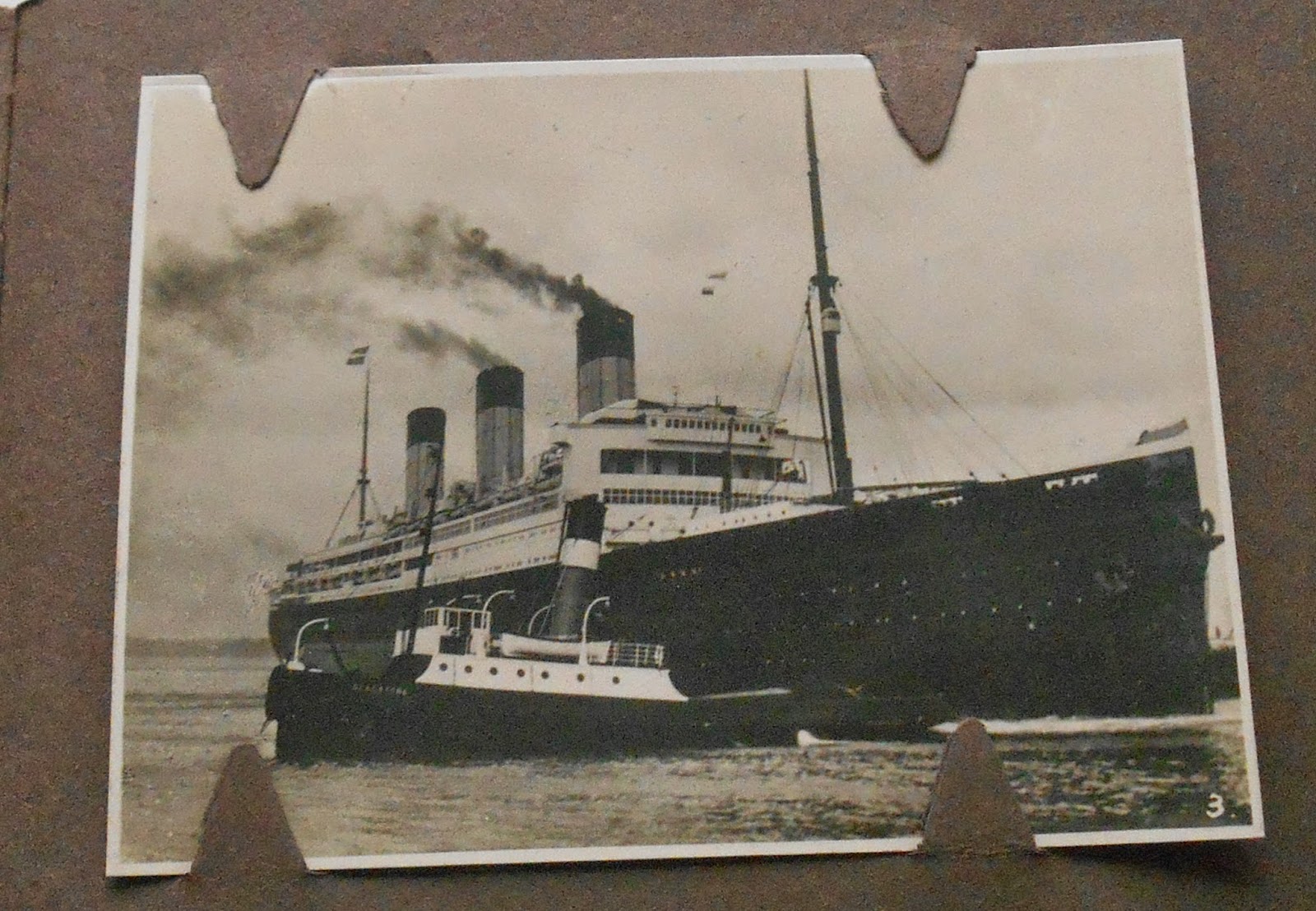
In this case however I have ten pictures, photographs to be exact, which turned up some months ago at the bottom of a box of books from an auction. They are actually snapshots of famous liners in a very small album, quite interesting and probably not worth a great deal in financial terms.


However there are some rather intriguing stories behind the ships pictured. I am not going to run through all of them, certainly the Queen Mary, Britannic and Normandie are all well known, but a bit of digging into a few of the others turned up some interesting facts.

I am sad to say SS Arandora Star was not particularly familiar to me, but the sinking of it during the World War II was something of a disaster. Over 800 were lost, including Italian and German internees, many from Scotland, as well as British military personnel. The German submarine involved was the U-47, which had a somewhat infamous reputation following its incursion into Scapa Flow and subsequent sinking of HMS Royal Oak, again with a large loss of life.


The Arandora Star was owned by Blue Star Line and was one of five liners which had been ordered together. What I find truly astounding though, is that all five ships were torpedoed by German submarines between 1940-1942, which even considering the amount of vessels lost during this period, does seem rather unlucky.

Another of the vessels pictured is the RMS Majestic, the largest ship ever owned by White Star Line and indeed the largest in the world for some time. However it was actually launched seven years before ever coming into their ownership, as it was originally built in Germany and was originally named the Bismarck. It was launched on the 20th June 1914, unfortunately eight days later Archduke Ferdinand was assassinated, war soon followed and the Bismarck sat unfinished.


So how did it come to be in White Star’s ownership, as a result of the Treaty of Versailles apparently. As it turns out the Bismarck and one of its sister ships, the Imperator were handed over to Britain as part of the reparations after the First World War, with White Star and Cunard gaining a ship each, the Imperator was renamed the Berengaria. The Majestic remained in service until 1936, during which time it appears to have had an interesting life, including colliding with its sister ship in Southampton and running the odd booze cruise during the American prohibition period.

The third and final ship that I looked into is the SS Asturias which completed its maiden voyage from Southampton to La Plata, Argentina in 1926. Again there is a wartime connection with the Asturias being refitted for use as an armoured merchant cruiser in 1939, before being torpedoed by an Italian submarine in 1943. While the ship did not actually sink as a result of the damage, it was considered to be a total loss after being towed into Freemantle.


This though was not the end of the story as in 1945 it was towed to Gibralter and then Belfast for repairs, before being used firstly on the immigration route to Australia, which is a whole story on its own, then secondly as a troop carrier.

All this is really only scratching the surface of the service lives of these three ships and let us not forget the other seven pictures within the album. So regardless of the doubters, it seems clear to me that even if a picture is not worth a thousand words, it can certainly provide the inspiration for a thousand and many more in my experience.


Andy

(Sources: White Star History, Ocean Liners, Blue Star Line, Clyde Marine, SS Asturias)

Wednesday, 3 September 2014

The Interesting Things That Books Contain.

One of the many great things about having numerous old books pass through your hands is the interesting discoveries that you make within the covers.

Obviously there are stories, knowledge and tales of adventure inside, but sometimes other items have found their way between the pages, creating in some cases a whole new story.

Without doubt pressed flowers are the most common discovery, particularly in large heavy books, but even these may have their own tale. They may just be a garden collection, possibly from a holiday abroad, or maybe they were accumulated during a series of travels. By whom, when and what for are reasons that may never become clear, but certainly there is another story with each collection.


Sometimes more material products turn up, the pound notes which are pictured all came from one book, between separate pages. Did they belong to a collector, or were they being tucked away for a rainy day?

Letters also make regular appearances, some of which are more interesting than others, but recently I found one which made me investigate further. At first glance it is just a regular note, written on shipping line paper, from somebody away on their travels in the 1960’s.  However on closer examination it becomes clear that this is from a couple emigrating from the United Kingdom to Australia in 1965, a time when many went to seek new horizons in these regions.


In reality this is not too unusual, but it is interesting to read a first hand account and the letter itself is very well written. Without the benefit of a surname it is quite difficult to actually trace who wrote the letter, although it would be interesting to know just how their new life turned out. I may in time manage to trace them through the shipping line passenger lists, but I do not hold out too much hope.

However that is only part of the story that this letter reveals, as the ship itself has an interesting history stretching over forty years. I probably should point out at this stage that I am a Historian by training, which makes it practically impossible to pass up the opportunity to dig into the past.

Nevertheless the ‘Castel Felice’ appears to have been an interesting vessel which completed 101 voyages carrying over 100,000 immigrants to New Zealand and Australia between 1952 and 1970, (source: Victoria Museum). There are numerous accounts of conditions on the vessel and tales of the journey around and I suppose the ship is a little bit of history, in the lives of these people.

The story of the ship though begins a lot earlier, 1930 was the launch date to be exact, and in its early days it was used on the India to Africa route by the British-India Steam Navigation Company under the name of ‘Kenya’. The dates may give away the next part of the ship’s life as World War II intervened.

At this point the vessel was refitted and seems to have sailed under the names of HMS Hydra and HMS Keren, being involved in landing operations in Sicily, North Africa and Madagascar. Following the war the ship was unused for a few years before being refitted for the immigrant trade, which is where the letter came in.

So a story within a story, if you see what I mean and one day maybe the identity of the writer will become clear, providing an end to the tale.  In the meantime I would be most interested to hear of any other interesting discoveries tucked between the pages of old books, who knows there may be another tale to investigate.


Andy